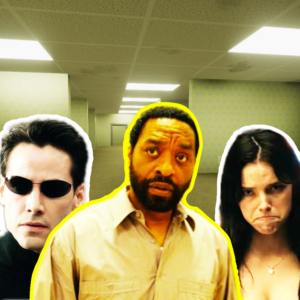
1999 was an incredible year for cinema. In the span of twelve months, audiences got Stanley Kubrick’s final film, Eyes Wide Shut, George Lucas returned to a galaxy far, far away with Star Wars: Episode I – The Phantom Menace, and the Wachowskis changed science fiction forever with The Matrix.
The Matrix wasn’t just a landmark for action and sci-fi filmmaking—it was a landmark for cinema itself. Much like Star Wars had done in 1977, it helped usher in a new era of visual effects and blockbuster storytelling. “Bullet time” became part of the cultural lexicon, but the film’s true staying power wasn’t found in its groundbreaking visuals.
At its core, The Matrix is essentially Plato’s Allegory of the Cave wrapped in leather trench coats and kung fu. It asks a deceptively simple question: if given the choice, would you choose comfortable illusion or uncomfortable truth? Would you take the blue pill or the red pill?

That question continues to echo through modern culture. The language of The Matrix has been appropriated, distorted, and repurposed by countless political and cultural movements online. The film transcended entertainment because it tapped into something universal: our fear that the world we know may not be the world as it truly is.
The Wachowskis created a dual reality. On the surface, humanity lived ordinary lives beneath sunny skies. Beneath that veneer lurked a ruined world dominated by machines. The film suggested that reality itself could be a prison—and that waking up carried its own terrible cost.
Its impact was enormous. It spawned sequels, an animated anthology, video games, comics, and influenced an entire generation of filmmakers. More than twenty-five years later, you can still see its DNA embedded in modern storytelling.
Cultural shifts in cinema don’t happen often.

The film industry itself is currently at an inflection point. The corporatization of film and television—once celebrated during the streaming boom of the 2010s—has transformed into something else entirely. Studios increasingly demand massive returns on investment. Mid-budget romantic comedies have largely disappeared. Quirky studio comedies are increasingly rare. Experimental dramas and grounded science fiction films struggle to secure funding. Even major science fiction projects like Project Hail Mary feel like exceptions rather than the rule.
Yet throughout every economic downturn, every cultural upheaval, and every shift in audience behavior, one genre continues to thrive:
Horror.
Horror has always been cinema’s greatest sandbox.
You can do anything within horror. It can be funny. It can be tragic. It can be deeply personal or wildly experimental. It can tackle social issues or explore abstract psychological concepts. Most importantly, compared to superhero blockbusters or large-scale science fiction epics, horror remains relatively inexpensive to produce.
Most horror films come and go without leaving much of a footprint. But every so often, something emerges that strikes a nerve. Something that begins as a simple idea before evolving into something culturally defining.
In 2026, we got two horror films in quick succession that felt exactly like that.
Obsession resonated because of its themes of agency, consent, and the complexities of modern relationships—taken, of course, to terrifying and darkly comedic extremes.
Then came Backrooms.
A feature film adaptation of a web series, itself inspired by an internet creepypasta, Backrooms should have been an odd curiosity. Instead, it became something much larger.
What The Matrix was to action science fiction, Backrooms may very well become for horror.
Its greatest strength lies in its restraint. The film demonstrates something studio executives and filmmakers alike should remember: less is often more. You don’t need A-list celebrities, city-destroying spectacle, or overwhelming visual effects to tell a compelling story.
You simply need something honest.
The liminal spaces of Backrooms resonate because they tap into experiences most people already understand. We’ve all had dreams where hallways stretch endlessly into darkness. We’ve all wandered unfamiliar buildings that somehow feel strangely familiar. We’ve all experienced moments of isolation where the world around us feels slightly off.
But the film’s true horror isn’t found in endless yellow hallways.
It’s found within ourselves.
How many people struggle with broken relationships? Depression? Addiction? Loneliness? The quiet weight of unresolved trauma? Therapy, alcohol, work, social media, substances—people seek countless ways to fill the empty spaces inside themselves.
Backrooms transforms those emotional voids into physical spaces.
Clark, portrayed by Chiwetel Ejiofor, is a furniture salesman living in the ruins of his own life. Divorced and depressed, he effectively lives inside his failing store until he discovers an impossible world hidden beneath it. The labyrinth he enters extends far beyond architecture. It becomes a manifestation of fear, regret, memory, and emotional isolation.
The Backrooms aren’t simply a place.
They’re a state of mind.
Much has already been written about the film’s mysteries and mythology. Fans have dissected its symbolism and proposed countless theories. Some interpretations are more convincing than others.
What fascinates me most, however, is not the lore itself, but the potential impact this film may have on storytelling moving forward.
It’s difficult to recognize a cultural shift while living through it. The significance of influential works often only becomes clear in retrospect. But I suspect that ten years from now, we’ll look back at Backrooms as a defining moment in horror cinema—one that demonstrated audiences were hungry for stories that embraced ambiguity, atmosphere, and emotional truth over spectacle.
The best stories always invite us deeper. Every answer reveals another question.
That’s what made The Matrix endure. Beneath its action sequences and philosophical framework was an uncomfortable truth: sometimes the most frightening thing imaginable is discovering who we really are when the comforting illusions fall away.
Backrooms arrives at a similar destination through different means.

The endless corridors aren’t terrifying because something might be lurking around the next corner. They’re terrifying because they force us to keep walking. To sit with our thoughts. To confront the versions of ourselves we’ve carefully hidden away behind distraction, routine, and denial.
The deepest recesses of the human mind remain the final unexplored frontier. We carry entire labyrinths inside ourselves—filled with old wounds, forgotten fears, unrealized dreams, and doors we’ve convinced ourselves should never be opened.
Maybe that’s why liminal horror resonates so deeply right now.
In an age of constant connection, many people have never felt more isolated. In a world overflowing with information, certainty feels increasingly elusive. We’re all searching for meaning in spaces that often feel vast, indifferent, and impossible to navigate.
The real horror of Backrooms isn’t getting lost in an infinite maze.
It’s realizing that the maze may have been inside us all along.
And perhaps that’s the point both The Matrix and Backrooms ultimately share: reality isn’t something we simply inhabit. It’s something we actively construct, question, and survive.
The question isn’t whether you choose the red pill or the blue pill.
The question is whether you’re prepared for whatever waits on the other side of the door.

1999 was an incredible year for cinema. In the span of twelve months, audiences got Stanley Kubrick’s final film, Eyes Wide Shut, George Lucas returned to a galaxy far, far away with Star Wars: Episode I – The Phantom Menace, and the Wachowskis changed science fiction forever with The Matrix.
The Matrix wasn’t just a landmark for action and sci-fi filmmaking—it was a landmark for cinema itself. Much like Star Wars had done in 1977, it helped usher in a new era of visual effects and blockbuster storytelling. “Bullet time” became part of the cultural lexicon, but the film’s true staying power wasn’t found in its groundbreaking visuals.
At its core, The Matrix is essentially Plato’s Allegory of the Cave wrapped in leather trench coats and kung fu. It asks a deceptively simple question: if given the choice, would you choose comfortable illusion or uncomfortable truth? Would you take the blue pill or the red pill?
That question continues to echo through modern culture. The language of The Matrix has been appropriated, distorted, and repurposed by countless political and cultural movements online. The film transcended entertainment because it tapped into something universal: our fear that the world we know may not be the world as it truly is.
The Wachowskis created a dual reality. On the surface, humanity lived ordinary lives beneath sunny skies. Beneath that veneer lurked a ruined world dominated by machines. The film suggested that reality itself could be a prison—and that waking up carried its own terrible cost.
Its impact was enormous. It spawned sequels, an animated anthology, video games, comics, and influenced an entire generation of filmmakers. More than twenty-five years later, you can still see its DNA embedded in modern storytelling.
Cultural shifts in cinema don’t happen often.
The film industry itself is currently at an inflection point. The corporatization of film and television—once celebrated during the streaming boom of the 2010s—has transformed into something else entirely. Studios increasingly demand massive returns on investment. Mid-budget romantic comedies have largely disappeared. Quirky studio comedies are increasingly rare. Experimental dramas and grounded science fiction films struggle to secure funding. Even major science fiction projects like Project Hail Mary feel like exceptions rather than the rule.
Yet throughout every economic downturn, every cultural upheaval, and every shift in audience behavior, one genre continues to thrive:
Horror.
Horror has always been cinema’s greatest sandbox.
You can do anything within horror. It can be funny. It can be tragic. It can be deeply personal or wildly experimental. It can tackle social issues or explore abstract psychological concepts. Most importantly, compared to superhero blockbusters or large-scale science fiction epics, horror remains relatively inexpensive to produce.
Most horror films come and go without leaving much of a footprint. But every so often, something emerges that strikes a nerve. Something that begins as a simple idea before evolving into something culturally defining.
In 2026, we got two horror films in quick succession that felt exactly like that.
Obsession resonated because of its themes of agency, consent, and the complexities of modern relationships—taken, of course, to terrifying and darkly comedic extremes.
Then came Backrooms.
A feature film adaptation of a web series, itself inspired by an internet creepypasta, Backrooms should have been an odd curiosity. Instead, it became something much larger.
What The Matrix was to action science fiction, Backrooms may very well become for horror.
Its greatest strength lies in its restraint. The film demonstrates something studio executives and filmmakers alike should remember: less is often more. You don’t need A-list celebrities, city-destroying spectacle, or overwhelming visual effects to tell a compelling story.
You simply need something honest.
The liminal spaces of Backrooms resonate because they tap into experiences most people already understand. We’ve all had dreams where hallways stretch endlessly into darkness. We’ve all wandered unfamiliar buildings that somehow feel strangely familiar. We’ve all experienced moments of isolation where the world around us feels slightly off.
But the film’s true horror isn’t found in endless yellow hallways.
It’s found within ourselves.
How many people struggle with broken relationships? Depression? Addiction? Loneliness? The quiet weight of unresolved trauma? Therapy, alcohol, work, social media, substances—people seek countless ways to fill the empty spaces inside themselves.
Backrooms transforms those emotional voids into physical spaces.
Clark, portrayed by Chiwetel Ejiofor, is a furniture salesman living in the ruins of his own life. Divorced and depressed, he effectively lives inside his failing store until he discovers an impossible world hidden beneath it. The labyrinth he enters extends far beyond architecture. It becomes a manifestation of fear, regret, memory, and emotional isolation.
The Backrooms aren’t simply a place.
They’re a state of mind.
Much has already been written about the film’s mysteries and mythology. Fans have dissected its symbolism and proposed countless theories. Some interpretations are more convincing than others.
What fascinates me most, however, is not the lore itself, but the potential impact this film may have on storytelling moving forward.
It’s difficult to recognize a cultural shift while living through it. The significance of influential works often only becomes clear in retrospect. But I suspect that ten years from now, we’ll look back at Backrooms as a defining moment in horror cinema—one that demonstrated audiences were hungry for stories that embraced ambiguity, atmosphere, and emotional truth over spectacle.
The best stories always invite us deeper. Every answer reveals another question.
That’s what made The Matrix endure. Beneath its action sequences and philosophical framework was an uncomfortable truth: sometimes the most frightening thing imaginable is discovering who we really are when the comforting illusions fall away.
Backrooms arrives at a similar destination through different means.
The endless corridors aren’t terrifying because something might be lurking around the next corner. They’re terrifying because they force us to keep walking. To sit with our thoughts. To confront the versions of ourselves we’ve carefully hidden away behind distraction, routine, and denial.
The deepest recesses of the human mind remain the final unexplored frontier. We carry entire labyrinths inside ourselves—filled with old wounds, forgotten fears, unrealized dreams, and doors we’ve convinced ourselves should never be opened.
Maybe that’s why liminal horror resonates so deeply right now.
In an age of constant connection, many people have never felt more isolated. In a world overflowing with information, certainty feels increasingly elusive. We’re all searching for meaning in spaces that often feel vast, indifferent, and impossible to navigate.
The real horror of Backrooms isn’t getting lost in an infinite maze.
It’s realizing that the maze may have been inside us all along.
And perhaps that’s the point both The Matrix and Backrooms ultimately share: reality isn’t something we simply inhabit. It’s something we actively construct, question, and survive.
The question isn’t whether you choose the red pill or the blue pill.
The question is whether you’re prepared for whatever waits on the other side of the door.